Features
Part of Explanatory essay guide for science and technology topics
Rewriting a misleading energy comparison as a clear explainer: a case
Energy comparison rewrite case fixing power-energy confusion, mismatched time periods, hidden assumptions, conversion precision, system boundaries, and uncertainty.
What to take away
- Compare energy with energy and power with power.
- Put both quantities on the same time basis and system boundary.
- Show the conversion factor and preserve source precision.
- Separate rated capacity from measured output.
- State what the result does not prove about cost, emissions, or reliability.
This fictional case begins with a dramatic sentence:
One wind turbine makes enough electricity to run 3,000 homes forever.
The sentence confuses a machine's power rating with energy over time, assumes an undefined household use, ignores variable output, and turns an annual illustration into a permanent promise.
Step 1: Identify each quantity
The draft's source file contains:
- turbine nameplate capacity
- 3 megawatts;
- reported annual generation in one year
- 9,200 megawatt-hours;
- regional household electricity use estimate
- 10,600 kilowatt-hours per household per year.
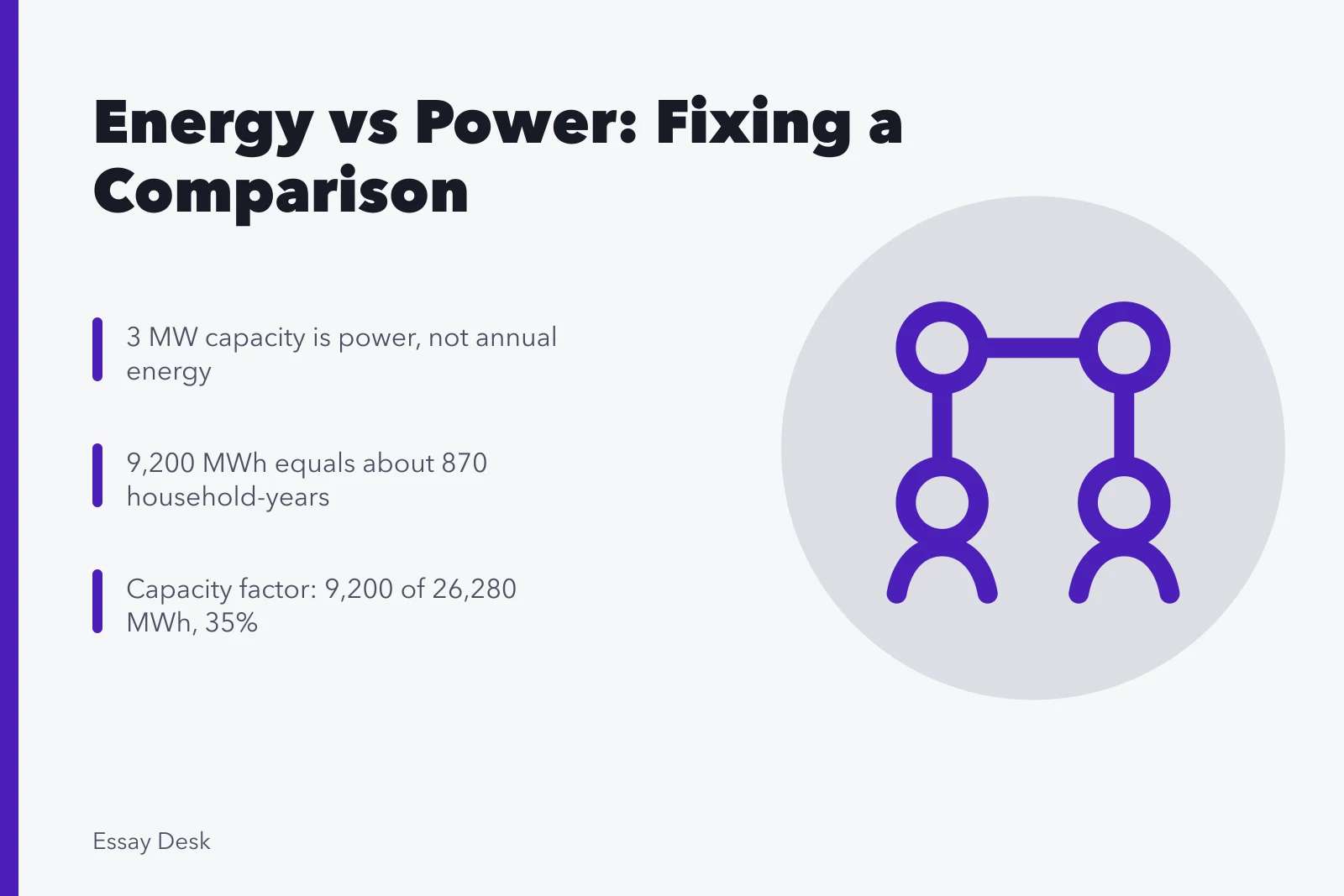
Capacity is a maximum power rating under specified conditions. Annual generation is energy produced across a year. Household use is annual energy consumed. Only the final two values can be compared directly after unit conversion.
Natural Resources Canada's energy efficiency glossary defines the watt as a measure of power, for example, a 40-watt bulb draws 40 watts.
It defines the kilowatt-hour as the commercial unit of electrical energy equal to 1,000 watt-hours, pictured as ten 100-watt bulbs burning for an hour. That distinction repairs the draft's basic category error.
Step 2: Put values on one basis
Convert annual turbine generation:
One Basis: Annual kWh
- 9,200,000 kWhturbine annual generation
- 10,600 kWhhousehold annual use
- 868household-years equivalent
9,200 MWh x 1,000 kWh/MWh = 9,200,000 kWh.
Then divide by the stated household estimate:
9,200,000 kWh / 10,600 kWh per household-year = about 868 household-years of electricity use.
The arithmetic supports roughly 870 average households for one year under these assumptions, not 3,000 homes forever.
Step 3: Preserve the observed period
The generation value comes from one particular year. Wind conditions, downtime, curtailment, maintenance, and equipment performance can change annual output.
Revision:
In the reported year, the turbine generated 9,200 MWh. That is numerically equal to the annual electricity use of about 870 households at the stated regional average of 10,600 kWh per household.
"Numerically equal" is deliberate. The electricity does not necessarily flow to a fixed group of homes.
Step 4: Explain capacity factor without hiding assumptions
The turbine's theoretical maximum annual energy at full rated power would be:
Capacity Factor About 35%
35% | observed generation / theoretical maximum
26,280 MWh | 3 MW x 8,760 hours
9,200 MWh | metered annual generation
3 MW x 8,760 hours = 26,280 MWh.
Observed generation divided by that maximum is about 35 percent. This ratio is the capacity factor for the stated period. It reflects actual output relative to continuous full-power output, not simple efficiency.
The explainer does not need the ratio to make the household comparison, but it helps explain why multiplying rated power by a year overstates generation.
Step 5: Check conversion sources
Energy types use different physical units, so the EIA overview of energy units and conversion explains fuels must be converted to a common energy unit for comparison. Fuel heat content can vary with composition, so conversion factors get updated.
A later comparison between electricity and gas must state whether it compares delivered energy, input energy, cost, or useful heat.
Step 6: Separate three questions
The first draft blurs output, cost, and emissions.
| Question | Needed evidence |
|---|---|
| How much electricity was generated? | Metered MWh and period |
| What did generation cost? | Defined cost method, financing, operation, connection, and period |
| Which emissions were avoided? | Counterfactual generation mix, timing, losses, and emissions boundary |
An energy-equivalent statement cannot answer the other two.
Step 7: Add system boundaries
The household-use comparison excludes transmission and distribution losses unless both source values account for them consistently. It also says nothing about when households demand electricity or when the turbine produces it.
For reliability claims, the explainer would need grid context, demand profile, storage, interconnection, other generators, outages, and geographic diversity. Annual totals can match while hourly patterns differ.
Step 8: Rewrite the complete passage
The 3 MW turbine generated 9,200 MWh during the reported year. Using the regional estimate of 10,600 kWh of household electricity use per year, that output is numerically equivalent to the annual consumption of roughly 870 average households. The comparison describes annual energy, not a dedicated supply to those homes. Output varies with wind, downtime, and curtailment, and the figure does not by itself establish cost, emissions avoided, or reliability.
The revision is less spectacular and far more useful.
Audit table
| Error | First draft | Revision |
|---|---|---|
| Quantity | Power treated as energy | Annual MWh compared with annual kWh |
| Time | "Forever" | Reported year |
| Household | Undefined | Regional annual estimate |
| Output | Nameplate assumed | Metered generation |
| Delivery | Implied dedicated supply | Numerical equivalence only |
| Wider claims | Cost and reliability implied | Explicitly outside scope |
Common questions
Is "homes powered" always a bad comparison?
No. It can orient scale if household use, period, output basis, and limits are stated.
Is capacity factor the same as efficiency?
No. Capacity factor compares actual output with maximum possible output at full rated power over the period.
Why not use the turbine's 3 MW rating?
It is power, not annual energy, and the turbine does not operate at full rated output every hour.
Does matching annual energy mean supply matches household demand?
No. Annual totals do not reveal hourly timing, delivery paths, losses, or reliability.