Rules
Part of Explanatory essay guide for science and technology topics
Technical explainer problems: false precision, broken analogies and scale errors
Technical explainer problems diagnosed and repaired: false precision, broken analogies, jargon, unit mistakes, power-energy confusion, and scale errors.
What to take away
- Extra decimal places do not create extra knowledge.
- An analogy fails when readers transfer the wrong relation.
- Replacing every technical term can destroy the concept being explained.
- Unit, denominator, and time errors can reverse a comparison.
- Readability scores cannot test factual meaning.
Technical prose can be grammatically simple and scientifically wrong. The failures below arise when clarity techniques are applied without checking the model.
Problem 1: False precision
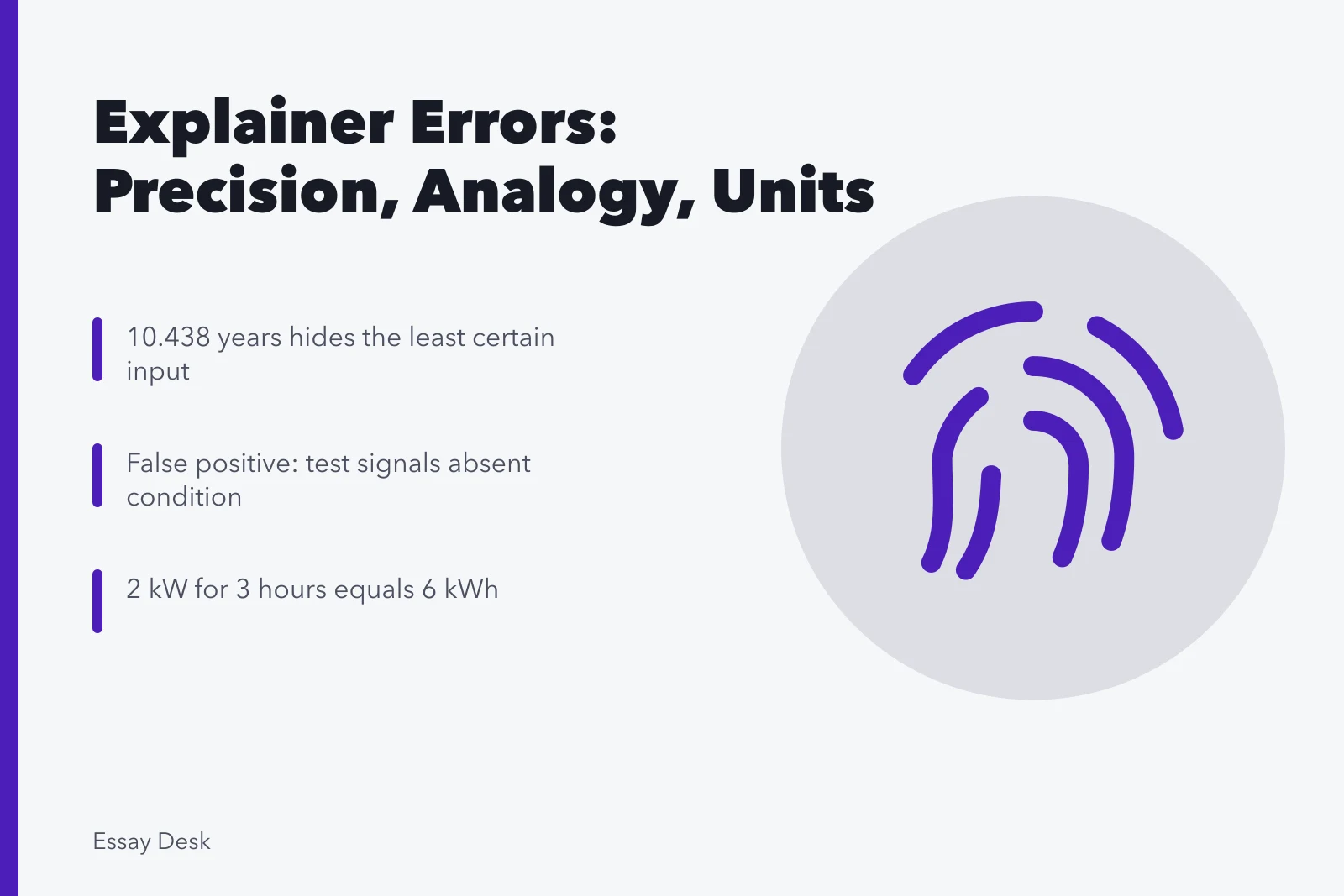
Draft: "The battery will last 10.438 years."
The estimate may come from a calculator using a measured capacity, assumed daily use, temperature profile, and degradation model. Reporting three decimal places hides those uncertainties.
Repair:
- Find the least certain consequential input.
- Preserve the model's range or scenarios.
- Round to the precision the evidence supports.
- Name the assumptions.
Revision: "Under the stated daily-use and temperature assumptions, the model estimates roughly 9 to 11 years; heavier use or sustained heat would shorten that interval."
Problem 2: Broken analogy
Draft: "A neural network thinks like a brain."
The analogy transfers agency, architecture, learning conditions, energy use, and biological function without specifying the shared relation.
Repair: identify the narrow match. "Both systems adjust patterns of connection in response to inputs, but the model's units, training objective, data exposure, and operation are not biological neurons, development, or human thought."
An analogy is a temporary bridge. Give readers a marked exit.
Problem 3: Jargon removal that removes meaning
Draft term: "false positive."
Bad simplification: "a wrong result."
A false positive is a particular error: a test indicates the target condition when that condition is absent. "Wrong result" erases the direction and prevents comparison with a false negative.
Define the technical term in plain language and keep it. Readers often need the name to follow later evidence.
The CDC clear-writing module Get to the Point warns that readability formulas can encourage writers to omit needed concepts, skip definitions, and chop sentences into prose that scores easily but loses meaning. Use readability as one diagnostic, never as a truth test.
Problem 4: Power and energy confusion
Draft: "The device uses 2 kilowatts per hour."
Power vs Energy Units
Kilowatts (power)
- What it measures
- rate of transfer
- Example device
- 2 kW device
- Time basis
- instantaneous
- Result
- 2 kW
Kilowatt-hours (energy)
- What it measures
- amount of energy
- Example device
- 2 kW device
- Time basis
- over 3 hours
- Result
- 6 kWh
Kilowatts measure power, a rate of energy transfer. Kilowatt-hours measure energy. A 2 kW device operating for three hours uses 6 kWh, ignoring changing load.
Repair every quantitative sentence with a dimensional check:
quantity = value x unit x time basis x system boundary
Do not compare a plant's megawatt capacity with a household's monthly kilowatt-hour use without converting both to energy over a stated period and accounting for actual output.
Problem 5: Conversion with invented digits
A source reports a length as 12 feet. A conversion tool returns 3.6576 meters, and the article prints every digit.
NIST's rules for expressing values of quantities explain that significant digits convey numerical precision and that unit prefixes can make values easier to understand. The converted value should not imply measurement precision absent from the original.
Repair: preserve the source precision and state whether the source number was measured, nominal, or rounded.
Problem 6: Denominator drift
Draft: "The new treatment cut risk by 50 percent."
The underlying change may be from 2 in 1,000 to 1 in 1,000. The relative reduction is 50 percent; the absolute difference is 1 per 1,000. Both can be accurate, but each answers a different question.
Repair: give the compared frequencies, time period, population, and relative result.
Problem 7: Scale without boundary
Draft: "Data centers use more water than cities."
Scope Table for Scale Claims
- Systemnamed facilities or sector
- Geographyregion
- Periodyear or operating interval
- Quantitywithdrawal, consumption, or discharge
- Boundarydirect, purchased energy, or life cycle
- Comparatornamed city set on same basis
Which data centers, cities, period, water category, geography, and accounting boundary? Withdrawal is not consumption. Direct onsite water is not necessarily the full supply-chain footprint.
Repair with a scope table:
Field / Required value
- System
- Named facilities or sector
- Geography
- Region
- Period
- Year or operating interval
- Quantity
- Withdrawal, consumption, or discharge
- Boundary
- Direct, purchased energy, or life cycle
- Comparator
- Named city set on same basis
Problem 8: Visual scale error
A pictogram doubles an icon's width and height to depict twice the value. Its area becomes four times as large, exaggerating the difference.
Repair: encode values on one visual dimension or use a properly scaled chart. Label axes and zero treatment.
Repair sequence
- Name each quantity and unit.
- Restore baselines and denominators.
- Remove unsupported digits.
- Define necessary terms.
- Mark analogy mappings and breaks.
- Test system boundaries.
- Audit visual scale.
- Ask a reader to explain the model back.
Common questions
Are decimal places always evidence of false precision?
No. They are appropriate when measurement and method support them and the use requires them.
Should all jargon be removed?
No. Keep terms readers need, define them, and remove unnecessary status language.
Is relative risk misleading?
Not by itself. Pair it with absolute frequencies, population, and period so readers can interpret magnitude.
Can an analogy be partly wrong and still useful?
Yes, if the matching relation and material limits are explicit.