Maintenance
Part of Explanatory essay guide for science and technology topics
Technical analogy, uncertainty, number, and source checklist
Technical explainer checklist for analogy limits, uncertainty, units, significant digits, baselines, source fit, diagrams, accessibility, and expert review.
What to take away
- Test the explainer's mental model, not only its sentence readability.
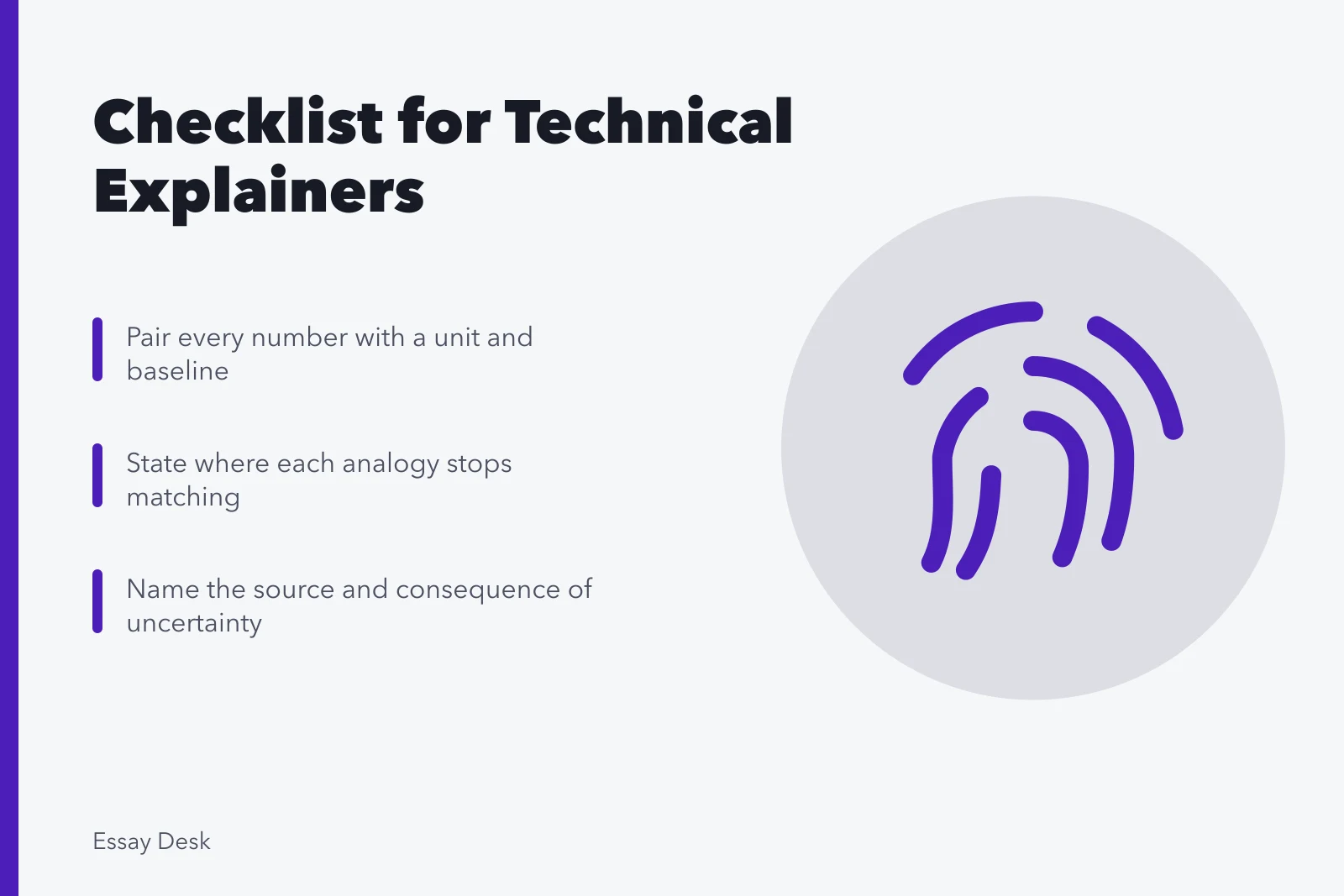
- Give quantities units, context, precision, and comparisons.
- Name the source and consequence of uncertainty.
- State where every analogy stops matching.
- Use sources suited to each factual and causal claim.
This checklist is for science and technology explanations written for informed nonspecialists. Run it before expert review and again after layout.
1. Explanation target
- The main question is stated in one sentence.
- The intended reader's prior knowledge is defined.
- The opening supplies the answer or mental model early.
- The system boundary and operating conditions are named.
- Secondary history does not delay the explanation.
- The reader can tell definition, evidence, interpretation, and advice apart.
2. Terms and concepts
- Every necessary technical term is defined before use.
- One concept is not renamed for stylistic variety.
- Nearby terms are distinguished with examples or nonexamples.
- Abbreviations are limited and expanded at first use.
- Personifying shorthand is unpacked into a physical or computational relation.
- The simplification does not reverse cause and effect.
3. Quantities and units
For every number, verify:
Number and unit verification
- Quantity measured or estimated
- Unit and unit symbol
- Population or system boundary
- Time interval
- Baseline or denominator
- Mean, median, range, or rate
- Observed, modeled, forecast, or assumed
- Precision supported by source
NIST's guidance on writing SI units treats a quantity value as a number paired with a unit, explains scale prefixes, and advises against reporting more significant digits in a conversion than the original data justify. Preserve that discipline even when adding an everyday comparison.
4. Comparisons and scale
- Compared quantities measure the same property.
- Units are converted on the same basis.
- Power and energy are not confused.
- Per-capita, per-area, and total values are labeled.
- Nominal and inflation-adjusted money are distinguished.
- The time basis is identical.
- Efficiency, capacity, and actual output are not substituted for one another.
5. Uncertainty
- The uncertainty source is namedmeasurement, sampling, model, future conditions, natural variation, or incomplete knowledge.
- A range or interval includes its meaning.
- Probability and outcome frequency are not confused.
- Verbal labels do not replace a reported numeric probability.
- The uncertainty's effect on the conclusion is explained.
- Unknown does not become zero.
- Conflicting studies are not averaged without a reason.
European Food Safety Authority guidance on communicating uncertainty in scientific assessments recommends retaining numeric probability when assessors provide it, keeping uncertainty separate from the frequency of an outcome, and using frequencies where they help readers understand incidence. Its specific conventions may not fit every field, but the separation test is broadly useful.
Uncertainty communication checks
- Name uncertainty source
- Range includes its meaning
- Separate probability from frequency
- Keep numeric probability
- Explain effect on conclusion
- Unknown is not zero
- Do not average conflicting studies
6. Analogies
- The source and target share the relation needed for the explanation.
- Surface resemblance is not doing the work.
- The mapping is stated explicitly.
- At least one important break is named.
- The analogy does not imply agency, scale, reversibility, or speed falsely.
- The direct explanation follows the analogy.
- Removing the analogy was considered.
7. Sources
- The original study, dataset, standard, or technical document was checked.
- A review supports synthesis across studies.
- A press release is not used for a method detail available in the paper.
- The linked page contains the evidence stated beside it.
- Corrections, updates, and versions were checked.
- Funding, sample, definitions, and limits are recorded.
- The source applies to the population and conditions in the sentence.
8. Visuals
- The visual has a clear explanatory job.
- Axes, units, scale, direction, and boundaries are labeled.
- Color is not the only carrier of meaning.
- Alternative text conveys the relevant relation.
- Decorative images are not presented as evidence.
- The caption states source, conditions, and limits.
- A diagram's omitted parts are disclosed where material.
9. Review tests
- A subject expert checked facts and simplifications.
- A target reader explained the model back.
- The reader can distinguish what is known from what is estimated.
- Predictable misconceptions were tested.
- Corrections from expert review reached every affected sentence and visual.
- The conclusion matches the evidence's scope.
Common questions
Should I round every technical number?
Round for the explanation's purpose without claiming more precision than the source supports. Preserve exact values where thresholds or reproducibility require them.
Is a confidence interval the same as a probability that the result is true?
Not generally. Explain the interval under the method used rather than substituting intuitive wording.
Can Wikipedia orient technical research?
Yes, but verify consequential claims in original standards, papers, datasets, or institutional documentation.
What if expert and reader feedback conflict?
Keep the expert-correct model and redesign the route by which the reader reaches it.