Maintenance
Part of Essay writing fundamentals: question, thesis, structure, and evidence
Essay planning, drafting, and structural review checklist
Essay checklist for defining the question, audience, thesis, evidence, section order, paragraph jobs, counterarguments, source gaps, revision, and proofing.
What to take away
- Define the essay's question, reader, length, genre, and evidence before locking the thesis.
- Plan necessary reasoning moves, not a fixed number of paragraphs.
- Draft with visible source gaps instead of inventing connective facts.
- Review each paragraph for one main job and an explicit inference.
- Complete structural, evidentiary, sentence, and proofing passes separately.
Use this checklist for an academic or researched general-interest essay. Adapt citation form, voice, headings, and disclosure rules to the assignment or publication. A checked box should mean that the draft contains evidence of the decision, not that the writer glanced at the issue.
Define the assignment and reader
- Copy the exact prompt or commission into the working document.
- Mark instruction verbs such as explain, compare, interpret, evaluate, or argue.
- Record target length, deadline, format, citation style, and media requirements.
- Name the likely reader and what that reader already knows.
- State what the reader should understand, reconsider, or decide after reading.
- Identify any legal, ethical, privacy, or safety concern in the subject.
Frame the question
- Replace the topic label with a question.
- Bound the object, place, period, people, and mechanism where relevant.
- Write two plausible answers to test whether the question is open.
- Remove assumptions of motive, guilt, virtue, or causation from the wording.
- Confirm that core evidence is available.
- List what the essay will not attempt to cover.
Build a provisional thesis
- Answer the question in one or two specific sentences.
- Name a relationship, reason, interpretation, or criterion.
- Avoid a thesis that merely announces the topic.
- Replace universal terms unless evidence supports them.
- Write the strongest reasonable objection.
- Note what evidence would force the thesis to change.
Plan the reasoning moves
- State the question the essay answers.
- List the claims a reader must accept for the thesis to hold.
- Order those claims by dependency, starting with what the reader already grants.
- Name the evidence that carries each claim.
- Label each section's movedefine, compare, trace a cause, weigh a counterargument, interpret.
- Mark where a skeptical reader could stop agreeing.
University of Toronto advice on organizing an essay recommends thinking about genre during planning while warning that argumentative essays do not have one fixed shape. Build an outline around the proof readers need, not around a ritual introduction and three interchangeable points.
Reasoning moves for an essay
- List steps a skeptic must accept
- Define terms before dependent claims
- Group evidence by point
- Place counterarguments where they matter
- Add a turn or consequence
- Give sections action headings
Gather and mark evidence
- Match every factual claim to a source, observation, or record.
- Save page numbers, timestamps, captions, and stable URLs while researching.
- Separate quotation, paraphrase, summary, and personal inference in notes.
- Check the original source rather than citing a secondhand mention when possible.
- Use library catalogues and subject databases before general web searches.
- Match the method to the claimstatistics for rates, documents for decisions, interviews for experience, close reading for texts.
- Record conflicting evidence and uncertainty.
- Use a clear placeholder such as
[SOURCE NEEDED]for unresolved claims. - Write the sentence as it will read, for exampleThe bridge opened in [YEAR], according to [SOURCE NEEDED].
Draft the body first when useful
- Start with the section whose evidence and purpose are clearest.
- State the point before or near the evidence that develops it.
- Explain what each example proves and what it does not prove.
- Use transitions that name a relationship, not decorative connectors.
- Keep speculation visibly qualified.
- Draft the introduction after the essay's real direction is known if that helps.
Audit every paragraph
For each paragraph, write answers in the margin:
- What is this paragraph's one main job?
- Which sentence states that job?
- What evidence does the paragraph use, and where does it come from?
- What does the evidence prove, and what does it not prove?
- How does this paragraph depend on the one before it?
- If this paragraph were deleted, what would the reader lose?
Harvard's guide to the anatomy of a body paragraph identifies a main point, evidence, and analysis as linked elements, with the topic sentence connecting the paragraph to the larger argument. Use that functional model without forcing every paragraph into identical length or syntax. Repeat the audit after a structural change, since moving a paragraph changes the answers.
Paragraph audit questions
- What does it say?
- What does it do for the essay?
- Which evidence does it use?
- Where does analysis begin?
- How does it connect backward and forward?
- Does it contain more than one main point?
Review structure
- Read only title, thesis, headings, and topic sentences.
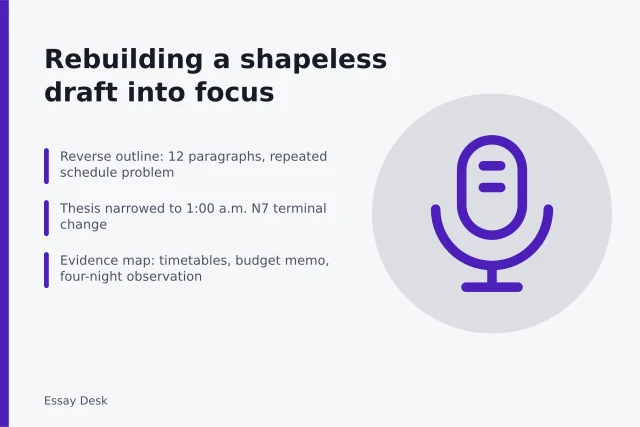
- Make a reverse outline from the draft as written. A short version might read: para 1 states the question, para 2 defines the measure, para 3 gives the strongest counterexample, para 4 answers it, para 5 states the limit.
- Find repeated moves, missing steps, and late-arriving premises.
- Reorder sections by logical dependency.
- Cut background that never affects the answer.
- Confirm that the conclusion follows from the evidence presented.
Review the opening and ending
- Open with the specific issue rather than a universal claim about society.
- Supply only the context needed to understand the question.
- State or strongly orient readers toward the essay's central direction.
- Avoid promising material the body never delivers.
- Use the ending to state the earned consequence, limit, or changed view.
- Do not introduce a major unaddressed objection in the final paragraph.
Complete separate editing passes
- Whole-essay passargument, scope, and structure.
- Evidence, quotation, and attribution pass.
- Clarity, diction, rhythm, and repetition pass.
- Grammar, spelling, punctuation, and format pass.
- Link, caption, permission, and metadata pass.
Final integrity check
- Every quotation matches the source.
- Every paraphrase preserves the source's meaning.
- Every material counterexample receives fair treatment.
- Personal memory is not presented as independently verified fact.
- Composite scenes or invented details are not passed off as reporting.
- The title and description match the finished essay.
Common questions
Must the outline exist before drafting?
No. A rough forward outline can guide the first draft, and a reverse outline can reveal the structure that emerged.
Should every paragraph start with a topic sentence?
Not mechanically. Readers should still be able to identify the paragraph's main point and relationship to the essay.
When should the introduction be written?
Whenever it becomes useful. Many writers draft it after the body clarifies the true question and answer.
Is proofreading the same as revision?
No. Proofreading catches surface errors. Revision can change the thesis, evidence, structure, and scope.