
Guides
Essay writing fundamentals: question, thesis, structure, and evidence
A working question, a thesis that survives evidence, and body paragraphs with clear jobs show how an essay moves from first doubt to finished argument.
What to take away
- A topic names territory; a question creates work. If two answers are not imaginable, the question is a verdict in disguise.
- Write the thesis as a provisional answer, then let evidence narrow, qualify or overturn it.
- List what a fair skeptic must understand before accepting the thesis. Those steps are your section order.
- Every paragraph gets one jobdefine, present evidence, analyze, compare, answer an objection, or draw an implication.
- Revise order and substance first. Editing commas in a section that may be deleted wastes the pass.
An essay is a guided act of thought. It asks a question, develops an answer, shows its basis, and tells the reader why the result matters. That description holds for academic arguments, reported criticism, and personal essays whose surfaces look nothing alike.
Five paragraphs suit a short assignment. They are not a law. An exploratory piece needs as many moves as its question requires.
Start with a real question
"Urban trees" is a topic. "Why did two nearby neighborhoods end up with different tree cover after the same city program?" is a question. The second points toward comparison, records, causes, and limits.
A workable question is specific enough to answer in the space you have, open enough that the answer is not obvious, and framed without declaring its own conclusion. It must also connect to evidence you can actually obtain, whether that is a council minute, a canopy survey, or a morning spent counting empty tree pits.
Test it by writing two plausible answers. If only one is imaginable, the wording already holds a verdict. Rewrite until both fit.
Write a provisional thesis
The thesis is the essay's current best answer. It states a relationship, an interpretation, an evaluation, or a qualified position the essay can support. It is not a slogan, and it need not be grand.
Compare these. Weak: "Public libraries are important." Better: "Weekend library hours matter most in neighborhoods where students have limited home internet, so systemwide hour cuts spread the inconvenience unevenly."
The second names a condition, a consequence, and a claim evidence could challenge. That is the whole test.
University of Toronto writing guidance says an academic essay should answer a question and develop a thesis through reasoning and evidence, and it advises testing and revising your preliminary answer as the work develops. That general essay-writing guidance supports the distinction that matters here: commitment gives a draft direction, revision keeps the argument honest.
Build a chain of reasoning
List what a skeptical but fair reader must understand before accepting the thesis. Those required steps become the backbone.
For the library example the chain might run as follows:
- Define the proposed hour changes.
- Show which branches and users they affect.
- Establish why home internet access changes the cost of a closure.
- Weigh alternative services and their limits.
- Answer the strongest objection.
- Explain the broader consequence.
Order the moves by dependency. A reader cannot judge a consequence before understanding the policy, or assess unequal effects before seeing who uses the service and why.
Give paragraphs jobs
A paragraph may define a term, present evidence, analyze an example, or establish context. It may also compare alternatives, answer an objection, or draw an implication. Pick one. A paragraph with three unrelated jobs should be divided; one that only restates the thesis should be cut.
| Question | Useful answer |
|---|
Paragraph job check
- What does this paragraph say?
- What does it do?
- What evidence appears?
- What follows from it?
- Why is it here?
The University of North Carolina's paragraph handout asks four things of every paragraph. Its sentences must serve one controlling idea, refer to the thesis, and follow a definite plan rather than an arrival order, with each idea adequately explained and supported.
A paragraph that fails that last test usually needs evidence, not a better opening sentence.
Use evidence as material, not decoration
Evidence can be a document, a dataset, a close reading, or an observation. Evidence can also be an interview, an object, or a bounded piece of personal experience. Its value depends on the claim it is asked to carry.
For each point, ask what kind of evidence could establish it. Ask whether the source sits close enough to the event, text, or measurement. Ask whether it supports the whole claim or only part, what context would change its meaning, and whether a contrary example exists.
Introduce the evidence, quote only the necessary portion, then analyze it. A quotation is not analysis; you must say which words, numbers, or details carry the inference.
Draft in useful pieces
You do not have to compose from the first sentence to the last. Draft the section whose evidence and purpose are clearest, leave markers for missing facts, and return once the reasoning exists.
Keep separate passes for these items:
Separate drafting passes
- Question and scope
- Thesis and counterclaim
- Section order
- Paragraph purpose
- Evidence and attribution
- Sentence clarity
- Mechanical proofing
Editing commas in a section that may be deleted is poor use of attention.
Open at the point of pressure
An introduction establishes the subject, the problem or tension, the necessary context, and the essay's direction. It does not need a dictionary definition, a sweep through all of human history, or a dramatic claim the body cannot prove.
The conclusion delivers the result of the reasoning. It may clarify consequences, limits, applications, or the changed view the essay makes possible. Listing the preceding sections in shorter form is not a conclusion.
Final structural test
Read only the title, the thesis, the headings, and the first sentence of each paragraph. Can you follow the logic? Then write a one-line summary of every paragraph from the finished draft. Reorder, merge, split, or remove until the sequence earns its conclusion.
Common questions
Does every essay need an explicit thesis sentence?
No. Many public and personal essays imply their central claim. The writer should still know the controlling question and the answer the piece develops, because that knowledge decides what stays in the draft.
How many paragraphs should an essay have?
As many as its reasoning requires. Length, genre, evidence, and audience set the useful structure, not a fixed count. A paragraph that carries no distinct job is the one to cut.
Can a thesis change during drafting?
Yes. Evidence and counterarguments should be allowed to narrow, qualify, or overturn the provisional answer. A thesis that survives every source unchanged usually means the sources were not read closely.
What should be revised first?
Question, thesis, scope, and order. Sentence-level polish comes after the structure works, because rewriting a sentence you later delete is the most common waste in revision.
In this guide
- How to turn a broad topic into a workable essay questionLearn how to develop an essay question by narrowing a broad topic, testing its scope, and checking whether available evidence can support an answer.
- Expository, analytical, argumentative, and reflective essays comparedEssay types compared by purpose, question, evidence, thesis, structure, voice, reader promise, common misuse, and when each writing mode fits best.
- Essay planning, drafting, and structural review checklistEssay checklist for defining the question, audience, thesis, evidence, section order, paragraph jobs, counterarguments, source gaps, revision, and proofing.
- Weak thesis, list structure, repetition, and unsupported claim problemsEssay structure problems guide for weak theses, list organization, repeated points, unsupported claims, quote dumps, false transitions, broad openings, and endings.
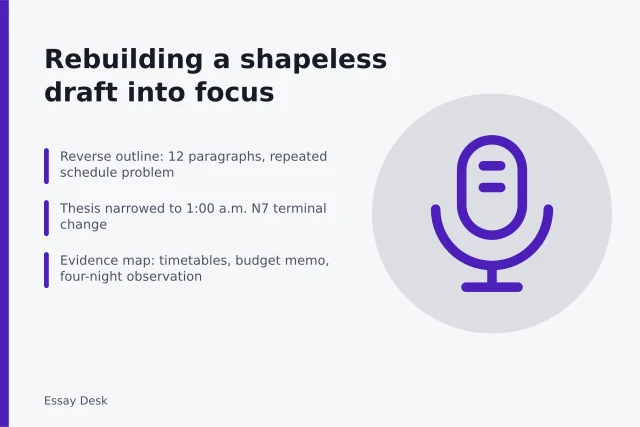
- Rebuilding a shapeless first draft into a focused essay: a worked caseEssay revision case showing how a night-bus draft gained a focused question, qualified thesis, evidence map, section logic, fair counterargument, and earned ending.