Guides
Every user submissions pair hides four answerable questions inside
User submissions arrive as finished pairs. Taking one apart gives four answerable questions and one that nobody, with two photographs, can answer.
Readers send pairs. That is the unit the format taught everyone to think in. It arrives as a finished object: two images, two names, one claim.
A desk can take the pair apart and hand back the parts. Almost everything interesting in a submission is in the parts; almost everything harmful is in the assembly.
What to take away
- The pair is a conclusion, and a conclusion is the least useful thing to receive because it hides the steps that produced it.
- Taking it apart gives the desk four questions it can answer.
- A reply that keeps the pair intact, even to disagree with it, has repeated the claim.
- What generated most submissions is not a face but a repeated co-occurrence, which the sender can usually identify once asked the right question.
What arrives, and what it is made of
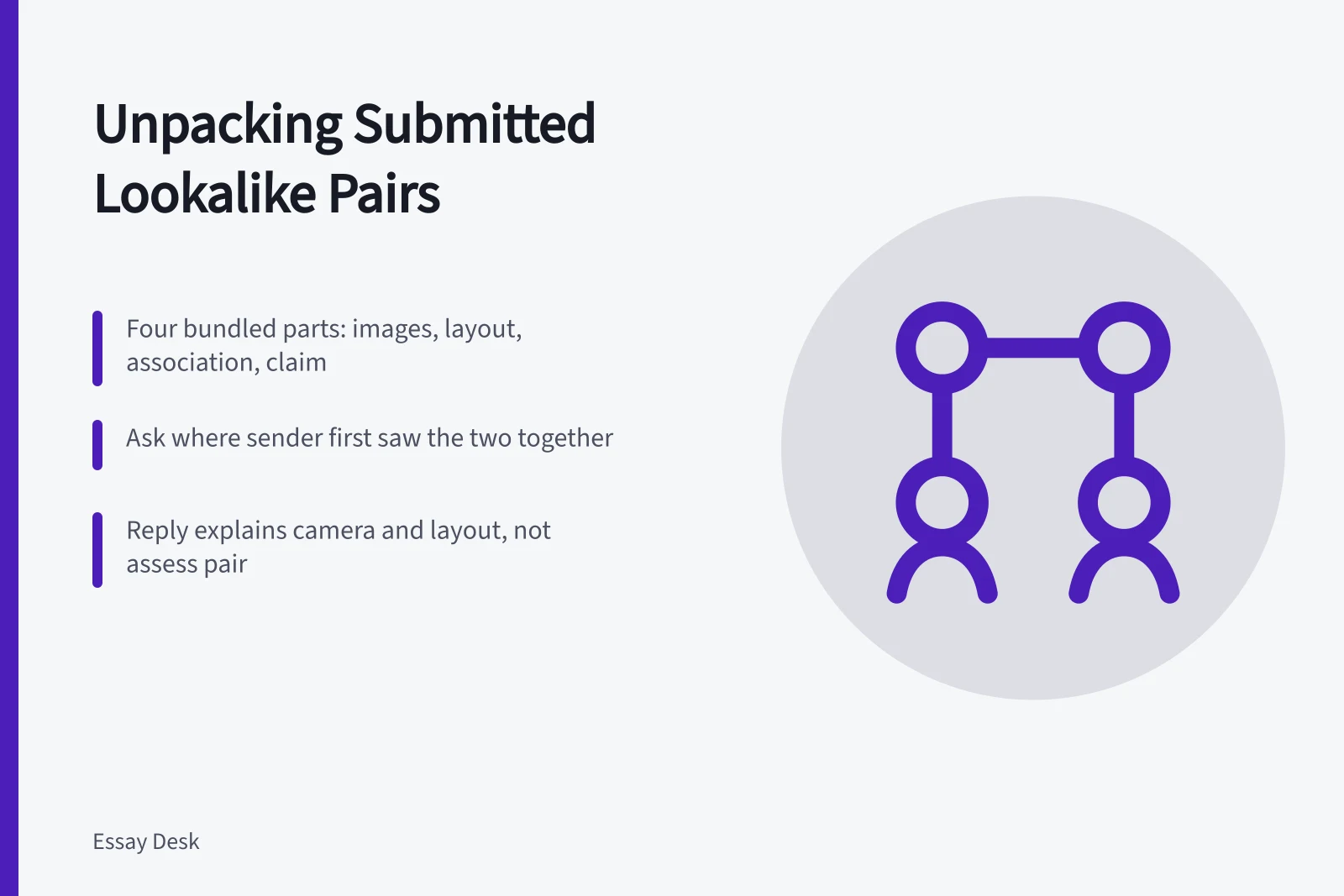
A submitted pair contains at least four things bundled together: two source images with their own histories, a layout decision, an association in the sender's memory, and a claim about two people. The sender experiences all four as one perception.
What a submitted pair contains
Component
- Image one
- Camera conditions
- Image two
- Camera conditions
- Paired layout
- What presentation adds
- Prior association
- Why these two
- Claim about two people
- Do they resemble
Question it answers
- Image one
- Yes, in general
- Image two
- Yes, in general
- Paired layout
- Yes, most useful
- Prior association
- Yes, surprises sender
- Claim about two people
- No, nobody can
Can the desk help?
- Image one
- Image two
- Paired layout
- Prior association
- Claim about two people
| Component | Question it answers | Can the desk help? |
|---|---|---|
| Image one, with its conditions | What did the camera do here? | Yes, in general terms |
| Image two, with its conditions | What did the camera do here? | Yes, in general terms |
| The paired layout | What does presentation add? | Yes, this is the most useful part |
| The prior association | Why these two rather than any others? | Yes, and it usually surprises the sender |
| The claim about two people | Do they resemble each other? | Not for this desk to answer |
Four of the five components have answers the desk can give.
The association usually came first
Ask a sender where they first saw the two people together. The answer is often a list of shared contexts: the same show, the same genre, the same era, the same kind of photograph.
The pattern is familiar: two actors billed as leads on the same long-running network drama, two presenters who fronted the same morning show, two singers who charted through the same decade. The association got built by co-occurrence, and the resemblance impression arrived afterward, dressed as a perception.
The habit of reading a relationship into two things that keep appearing together is ordinary and does not require carelessness. What it means practically is that a submission is often a report about a viewing history rather than about two faces, and that report is genuinely interesting to the person who made it.
The caption did some of the work too
Most pairs arrive already labeled, because the sender saw them labeled somewhere. A name, a category or a suggestion supplied in advance changes what gets noticed next, and being given the frame before the evidence is a well-described effect rather than an unusual failure.
One test separates the label from the pairing: would you have put these two together out of everyone you know, unprompted?
Taking the pair apart in a reply
What a good reply does
- Explain what camera distance does to a face
- Explain what a matched layout adds
- Ask where the sender first saw the two together
- Point at material that goes into detail
- Do not assess the pair
Four sentences cover most replies:
Thank you for sending these. I can explain how each image was made and how the pairing was presented, and why the two sit together in your memory. I cannot tell you whether they resemble each other, and no reply from this desk will try. Tell me where you first saw them together.
The refusal is not a hedge. There is no procedure by which anyone could assess it: two photographs made under unknown conditions do not carry the information. What is actually recoverable from a comparison image is the honest boundary, and why the paired format is so persuasive regardless is the mechanism the sender was subject to.
Why nothing goes back out with two names in it
A reply that repeats the pairing has published it a second time, in writing, from a desk that looks like an authority. That is worse than the original in one specific way: it looks confirmed.
The standing rules the desk works from rule it out. The same reasoning rules out scored formats built on named items. A score is a number attached to two names, and a number sent out from a desk reads as a finding. the guide to quiz scores explains what the desk does instead.
Senders almost never object once the reasoning is laid out, because most of them were not asking to publish anything. They wanted to know why they saw what they saw, and that question has a real answer.
Common questions
Why not just say the pairing is wrong?
Because that would be a claim too. Telling a sender their pairing is wrong still asserts something about two faces, and it puts both names in writing again.
Is it worth telling a sender their impression is a viewing artifact?
Only as a possibility to test, with the co-occurrence question. Delivered as a verdict it is just a different unsupported claim.
Does anything change if the sender is one of the two people?
The other name is still in the message, and that person did not send anything.