Guides
Misquotes and fact checks context for people who want the details
Misquotes and fact checks around interviews: what editing legitimately does to speech, where indirect speech becomes a quotation, and how to check the line.
A quotation from an interview is edited before you see it. That is not a scandal, and it is rarely dishonest. It is how speech becomes print.
But the sentence inside quotation marks comes from decisions someone made. Knowing which decisions were available explains many disagreements about what a person said.
This page is about that layer: what legitimately changes between a room and a page, what does not, and how to check a line that came from a conversation rather than from a text.
What to take away
- Speech and writing are different materials. Turning one into the other requires choices.
- Cleaning up delivery is standard. Changing the sense is not.
- The absence of a recording is the normal case, not a red flag.
- A line from an interview is evidence about that interview, not about the person's settled view.
What speech actually looks like
Transcribe two minutes of anyone talking and the result is unreadable. Real speech has false starts, repeated words, sentences that change direction halfway and never finish, and filler that carries no meaning. A verbatim transcript of ordinary conversation reads as incoherence, and printing it that way would misrepresent a competent speaker as a confused one.
So the transcript gets tidied. The conventional latitude covers filler removal, false starts, and the small repairs that make a spoken sentence parse on the page. It does not cover reordering clauses to change emphasis, joining answers to different questions, or removing a qualification.
That boundary is where most disputes live, and both sides are usually sincere. The speaker remembers the qualification. The writer removed it as verbal throat-clearing. Neither is lying.
The specific edits, ranked by risk
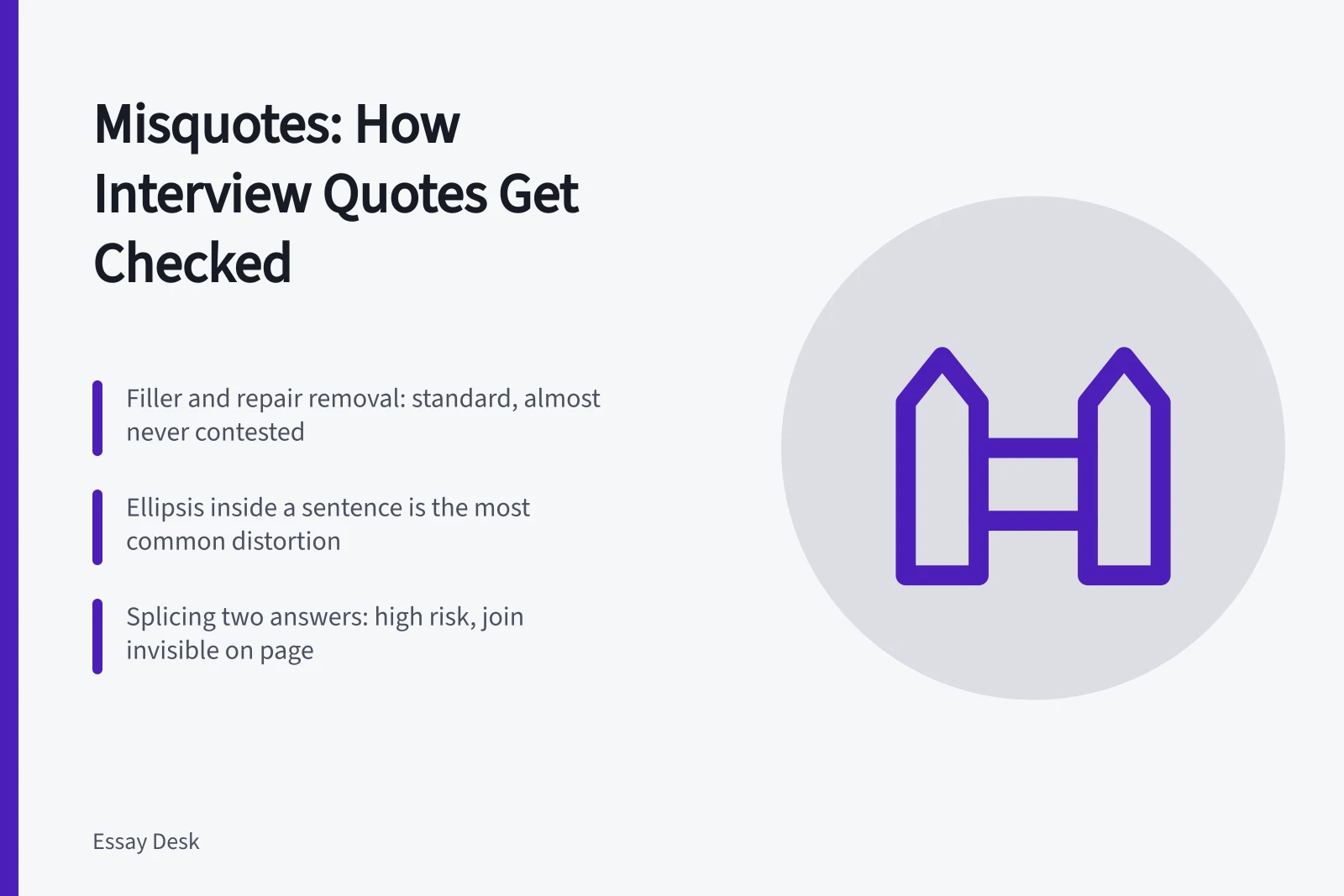
- Filler and repair removal.Standard. Almost never contested.
- Ellipsis inside a sentence.Usually fine, occasionally serious, because the removed stretch can be the limiting clause. This is the single most common way a quotation gains strength it never had.
- Splicing two answers.High risk. The join is invisible on the page and the resulting sentence was never uttered.
- Cleaning grammar.Fine for a fluent speaker, distorting for someone speaking a second language, whose actual phrasing may be the point.
- Translating.A different sentence entirely, produced by the translator, and it should be marked as such. The category where translated wording causes the most trouble sets out why.
Where a full transcript survives, all of these are checkable, which is why the transcript matters far more than the quotation. Where one does not, none of them are. Our account of how compression strengthens a line while weakening its truth applies here in miniature, with the compression happening in a single step rather than over decades.
Editing risk by type
Edit
- Filler removal
- Standard
- Ellipsis in sentence
- Usually fine
- Splicing answers
- High risk
- Grammar cleaning
- Fine if fluent
- Translating
- Different sentence
Risk
- Filler removal
- Almost never contested
- Ellipsis in sentence
- Can remove limiting clause
- Splicing answers
- Join invisible on page
- Grammar cleaning
- Distorting for L2 speakers
- Translating
- Must be marked as such
Direct and indirect
A great deal of confusion comes from the boundary between a quotation and a report of one. Grammatically these are distinct: indirect speech shifts pronouns and tenses and does not claim to reproduce wording. It says what someone conveyed, not what they uttered.
Indirect speech is one careless step from direct speech. A writer paraphrases in indirect form. A later writer, reading fast, restores the quotation marks and shifts the pronouns back.
The result is a quoted sentence nobody said. This is one of the largest single sources of quotations attributed to people who never produced them. It requires no dishonesty at any step.
When you see a quotation from an interview, the useful question is whether the earliest version of it was in quotation marks at all.
Checking a line from a conversation
| Question | Where the answer lives | If unavailable |
|---|---|---|
| Does a recording exist? | The outlet, or an archive | Very common. Not suspicious |
| Was there a transcript? | The outlet's own files | Usually not public |
| Is the earliest version direct or indirect? | The original piece, not the reprints | Assume indirect until shown otherwise |
| Was the quotation contested at the time? | Letters, corrections, later coverage | Silence is weak evidence either way |
| Is the wording stable across reprints? | Wire copy and syndicated versions | Drift indicates retelling, not the source |
Disciplines that collect speech deliberately have written their obligations down. The oral history association's principles and best practices states what a careful interviewer owes speaker and record: consent, an accurate account of what was recorded, and preservation of the material.
Checking a quotation
- Does a recording exist?
- Was there a transcript?
- Earliest version direct or indirect?
- Was the quotation contested at the time?
- Is wording stable across reprints?
Journalism's conventions are less uniform and less documented. That is part of why the boundary keeps getting argued.
The formal end of the spectrum
At the far end sits the verbatim record produced by a trained court reporter, where the standard is capture rather than readability, and where the transcript is the legal record of what was said. Proceedings, depositions, and hearings therefore give you something interviews almost never do: a complete, dated, uncleaned text.
If a remark was made in a setting like that, look for the transcript before anything else. It settles wording completely, and it usually shows that the circulating version has been trimmed. Our material on where professional and official records live covers what exists for different fields.
What an interview quotation is evidence of
One more thing worth saying, because it causes more harm than the editing does. A line from an interview is evidence that a person said something, on one occasion, in answer to a particular question, possibly without much thought. It is not evidence of a considered position, and it is certainly not a summary of their view.
Quotations get used the other way constantly: one sentence from one conversation stands in for a whole worldview. That misuse is separate from whether the transcription was accurate, and correct wording does not repair it.
The material on restoring the frame around a line covers what has to travel with a quotation to mean what it meant.
Common questions
Is it acceptable for a subject to review their quotations before publication?
Practice varies by outlet and by field, and it is genuinely contested. What matters for a checker is whether review happened, because a reviewed quotation may differ from what was said, and the published version is then a negotiated text.
If no recording exists, is the quotation worthless?
No. Most interview quotations have never had a public recording, and the practice long predates portable recording. It means the evidence is the reporter's contemporaneous note, which is weaker than a transcript and much stronger than a later recollection.
How should ellipses be read?
As a signal to find the full passage before relying on the sentence. An ellipsis is honest notation, and it is also the standard location of the missing qualification.
What if two outlets print different wordings from the same interview?
That usually means one of them worked from the other, or both worked from a summary. Find the earliest, and check whether it was direct speech or a report.