Guides
Part of Cultural criticism guide: object, context, interpretation, and stakes
How to close-read an image, scene, song, or designed object
Learn how to close read an image, film scene, song, or designed object by recording details, finding patterns, and testing claims against the work.
What to take away
- Describe what is literally present before you assign it meaning.
- Track repetition, contrast and absence, not single features in isolation.
- Use a medium's own terms only when they sharpen a specific claim.
- Bring in context after your first pass, and only context that changes the reading.
- Hunt for the detail that fights your interpretation, then say what it does to the claim.
Close reading is disciplined attention to how a work makes meaning. The work need not be verbal. A cut between shots, a bass line under a lyric, a grip shaped for one hand, a warning label placed out of sight: each carries an argument.
The sequence holds across media. Here are the key elements of the framework:
- Encounter
- inventory
- pattern
- question
- context
- claim
- resistance.
Apply the sequence to each medium
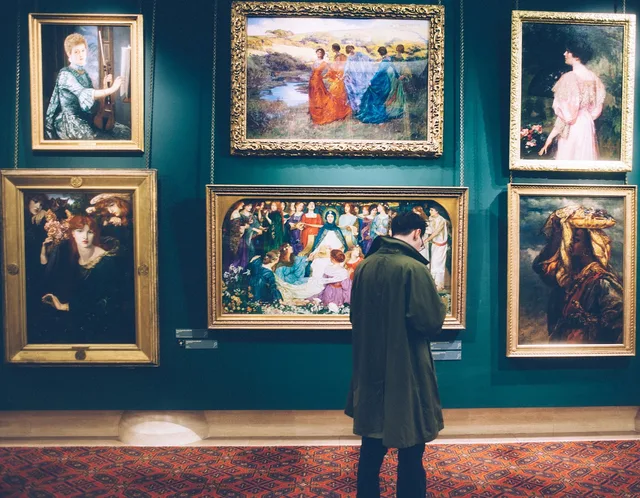
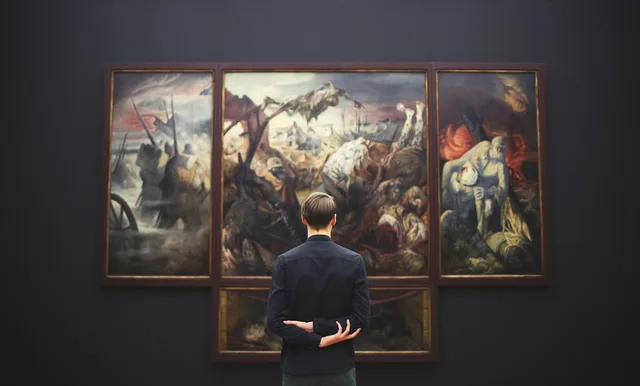
- Image: frame-and-caption pass.Encounter the particular image and its display conditions; inventory subjects, text, composition, light, and edges; mark repeated or contrasting features; ask how the frame directs attention; research relevant caption, maker, date, and audience; make a claim about a visible choice and its effect; then test it against a detail that complicates your reading.
- Scene: form-to-function pass.Fix the timestamp, edition, and sound conditions; inventory shots, movement, dialogue, and sound; track cuts and framing patterns; ask what those choices make you notice or feel; add relevant genre or production context; claim how a formal choice shapes the scene; then test the claim against a shot or sound that resists it.
- Song: sound-first pass.Identify the recording and mix; inventory the lyric, tempo, meter, harmony, timbre, dynamics, and phrasing; track what repeats or changes; ask what the sound does to the lyric or mood; add relevant release or performance context; claim how a specific musical choice affects the reading; then test that claim against a different line or musical passage.
- Designed object: use-centered pass.Identify the maker, model, condition, and setting; inventory material, interface, affordances, feedback, ergonomics, and wear; track repeated choices and omissions; ask who can use the object and under what conditions; consult relevant patents, advertisements, repair manuals, or evidence of wear; claim how a design choice shapes use; then test the claim against another user, feature, or context.
For a designed-object example, imagine a travel mug with a narrow groove in its lid. Observation: residue collects in the groove. Interpretation: the groove may help the lid seal while making it harder to clean. Stakes: ease of maintenance may compete with leak prevention, a claim to check against the lid's construction and use.
Fix the object and the conditions
Write down the exact version you met and how you met it.
- Imageoriginal or reproduction, crop, caption, platform, display size.
- Filmedition, timestamp, sound mix, subtitles, playback setting.
- Songrecording, release, mix, lyric source, playback format.
- Objectmaker, model, date, material, dimensions, condition, setting.
A crop removes evidence. Subtitles change tone. A museum case forbids touch. The conditions belong in your notes, because they shape what you were able to see.
Make a literal inventory
Give the description five minutes before interpretation gets a turn. Ban the words represents, symbolizes, and any guess at motive.
Three-Column Timed Media Log
- 0000 Empty hallway, centered door
- 0007 Hand enters left edge
- 0011 Door opens into darkness
For a still image, list the people, objects, visible words, and spatial relations. Also list the light, color, edges, and what falls outside the frame. The Library of Congress guide to analyzing photographs and prints uses five steps:
- meet the photograph
- observe
- reflect
- question
- investigate
The guide prompts you toward several things:
- arrangement
- setting
- visible text
- audience
- purpose
It also prompts you toward whatever the picture leaves out.
For timed media, keep a log. Three columns carry most of it: what you see, what you hear, what changes.
| Time | Image or action | Sound | Change | Question |
|---|---|---|---|---|
| 00:00 | Empty hallway, centered door | Low ventilation hum | Static | Why delay entry? |
| 00:07 | Hand enters left edge | Hum stops | Offscreen body implied | Who controls the cut? |
| 00:11 | Door opens into darkness | Footstep moves right | Sound gives depth | Why withhold the face? |
Find patterns and breaks
Mark these rhetorical figures:
- repetition
- contrast
- escalation
- symmetry
- interruption
- omission One red object may be accident. A red object returning at three decision points has earned its place in the argument.
Ask what happens when the pattern breaks. A song drops percussion under one line. A package uses soft language everywhere except the safety warning. A film abandons stable framing during a confrontation.
Borrow the medium's vocabulary
Medium-Specific Vocabulary
Image
- Core terms
- composition, scale, perspective, gaze
- Additional terms
- negative space, contrast, texture, caption, crop
Film
- Core terms
- shot size, camera movement, framing, focus
- Additional terms
- blocking, lighting, editing rhythm, sound perspective, performance
Song
- Core terms
- tempo, meter, harmony, timbre
- Additional terms
- register, dynamics, repetition, rhyme, phrasing, mix
Object
- Core terms
- material, interface, affordance, feedback
- Additional terms
- ergonomics, maintenance, modularity, packaging, wear
Choose the song term that names the audible feature you notice: tempo for speed, meter for how beats are grouped, harmony for chord movement, timbre for sound quality, register for pitch range, dynamics for loudness, phrasing for how a line is shaped, rhyme for a lyric pattern, and mix for the balance of sounds. Track a repeated or changed feature, then explain its effect instead of listing terms on their own.
- material
- interface
- affordance
- feedback
- ergonomics
- maintenance
- modularity
- packaging
- wear
A term earns its keep when it ties an observable choice to an effect. Calling something a close-up explains nothing yet. What does the close-up withhold, or make legible for the first time?
The University of North Carolina's film analysis handout sets the order of work: analyze what the form is, then what the form does. Raise a striking feature only where it bears on the argument. It also separates three terms people collapse. A shot ends at every cut. A scene is built from related shots. A sequence gathers related scenes.
Turn a detail into a claim
Climb three rungs, one sentence each: observation names what is literally present; interpretation explains what that choice does; stakes say why that effect matters to the reading.
Three Rungs of a Claim
- Observationinterface hides cancellation under neutral labels
- Interpretationhierarchy makes enrollment easier than exit
- Stakesdesign shifts effort to least profitable choice
Each rung must hold the one below it. Do not leap from a small feature to the designer's private intention, or to a claim about every user.
Add context in layers
Research the maker, the date, the genre, and the technology. Also research who it was made for and how it was later reused. Add only what changes your reading.
A patent explains a mechanism. An advertisement frames the intended user. A repair manual exposes maintenance assumptions. Wear shows use that departs from the design claim. Each source answers a question you already have; none of them substitutes for looking.
Test resistance
Find one feature that does not fit. If your claim says a scene isolates its protagonist, account for the one warm group shot. It may complicate the claim, narrow it to a sequence, or expose a failed reading.
Write the alternative explanation and compare which details each one accounts for. Keep the ambiguity when the work supports more than one coherent reading.
Draft in evidence units
Build each paragraph in this order:
- State the observation.
- Name the feature or pattern.
- Explain its effect.
- State the claim it supports.
- Add relevant context or comparison.
- Address a detail that qualifies or resists the claim.
Evidence Unit Paragraph Order
- Precise observation
- Where it sits in the work
- How the formal relation works
- Contextual evidence, if needed
- Interpretation
- Qualification or resistant detail
Summary orients the reader just long enough to make the analysis intelligible. Then get out of the way.
Common questions
These answers address practical questions that come up while close-reading images, scenes, songs, and designed objects.
How long should I observe before researching context?
Long enough to record your own details and questions without help. Then research, and return for a second observation pass to see what the first one missed.
Can absence count as evidence?
Yes, when a comparison or a convention establishes that the absence is meaningful rather than imagined. A missing element needs a reason to expect it. For example, if a designed object labels every control but one, compare that control with the others or consult its instructions before treating the missing label as significant.
Must I use technical vocabulary?
No. Use a term when it names a feature more precisely than ordinary language can. Otherwise plain description does the work.
Can two conflicting readings both be sound?
Yes. A work may organize genuine ambiguity, and each reading still needs specific evidence from the work.