
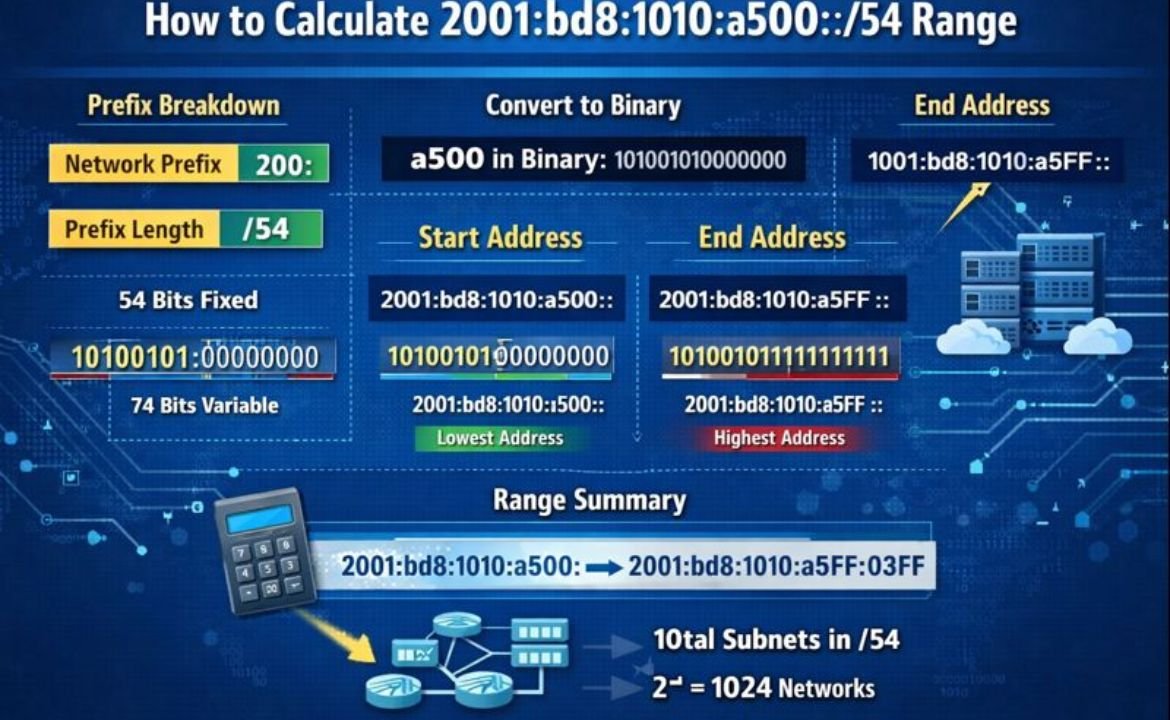
Understanding IPv6 addressing is an essential skill for modern network engineers, system administrators, and students. One common challenge is learning how to calculate 2001:bd8:1010:a500::/54 range correctly without confusion. This guide explains how to calculate 2001:bd8:1010:a500::/54 range in a clear, structured, and practical way. It uses simple logic, short sentences, and real understanding rather than memorization.
Introduction to IPv6 Addressing
IPv6 was designed to replace IPv4 due to address exhaustion. It uses 128-bit addresses written in hexadecimal format. These addresses are divided into prefixes and host portions.
An IPv6 prefix, such as /54, defines how many bits are reserved for the network. The remaining bits are used for subnetting and hosts. Learning prefix calculation helps with routing, planning, and security.
IPv6 addresses are written in eight groups called hextets. Each hextet contains 16 bits. Understanding this structure is the foundation of IPv6 range calculation.
Understanding the Structure of the Given Prefix
The prefix 2001:bd8:1010:a500::/54 consists of a network address and a prefix length.
Let’s break it down:
- 2001:bd8:1010:a500:: is the base address
- /54 means the first 54 bits are fixed
- The remaining 74 bits are available
Each hextet equals 16 bits. After three full hextets, you have 48 bits. The /54 prefix extends 6 bits into the fourth hextet.
This detail is crucial. It determines how many subnets and addresses exist in the range.
Converting the Fourth Hextet into Binary
The fourth hextet is a500. In hexadecimal, this converts to binary as follows:
- a = 1010
- 5 = 0101
- 0 = 0000
- 0 = 0000
So the full binary value is:
1010010100000000
Since the prefix is /54, the first 6 bits of this hextet are fixed. The remaining 10 bits in this hextet are variable.
This is where the range expansion happens.
Identifying the Network and Range Boundaries
The first 6 bits of the fourth hextet define the network portion. The remaining bits define the range.
In binary:
- Fixed bits: 101001
- Variable bits: xxxxxxxxxx
These variable bits can change from all zeros to all ones.
This means the range spans multiple values of the fourth hextet while the first three hextets stay the same.
Calculating the Start Address
To find the start of the range:
- Keep the fixed bits unchanged
- Set all variable bits to zero
This gives the lowest possible address in the range.
The resulting starting prefix represents the first usable block within the /54 network. All addresses from this point forward belong to the same allocation until the variable bits are fully exhausted.
Calculating the End Address
To find the end of the range:
- Keep the fixed bits unchanged
- Set all variable bits to one
This produces the highest possible value for the fourth hextet within the prefix.
All addresses between the start and end points are part of the same IPv6 prefix range.
This approach works for any IPv6 prefix length, not just /54.
Number of Subnets and Addresses
A /54 prefix leaves 10 bits free in the fourth hextet.
That means:
- 2¹⁰ = 1024 possible subnet variations
Each of these subnets can later be divided further, often into /64 networks. This is common practice in IPv6 design.
Understanding this flexibility is important for scalable network planning.
Practical Use Cases of a /54 Prefix
A /54 prefix is often assigned to organizations or data centers. It allows:
- Structured subnetting
- Logical separation of departments
- Efficient routing
Many administrators split a /54 into multiple /64 networks. This aligns with IPv6 best practices and simplifies configuration.
Common Mistakes to Avoid
Many learners make small but critical errors:
- Miscounting bits in the prefix
- Forgetting partial hextet boundaries
- Treating IPv6 like IPv4
IPv6 requires binary thinking. Once you focus on bits instead of colons, calculations become much easier.
Another mistake is assuming every hextet is either fully fixed or fully variable. Prefixes like /54 prove that partial hextets matter.
Tips for Faster IPv6 Calculations
Here are a few practical tips:
- Memorize hextet-to-bit relationships
- Always convert partial hextets to binary
- Write out fixed and variable bits clearly
- Double-check prefix boundaries
With practice, you will calculate IPv6 ranges quickly and accurately.
Final Thoughts
Learning how IPv6 ranges work is a valuable technical skill. Once you understand prefix lengths, binary conversion, and bit boundaries, how to calculate 2001:bd8:1010:a500::/54 range becomes manageable.
